Latest Readings by Clive James
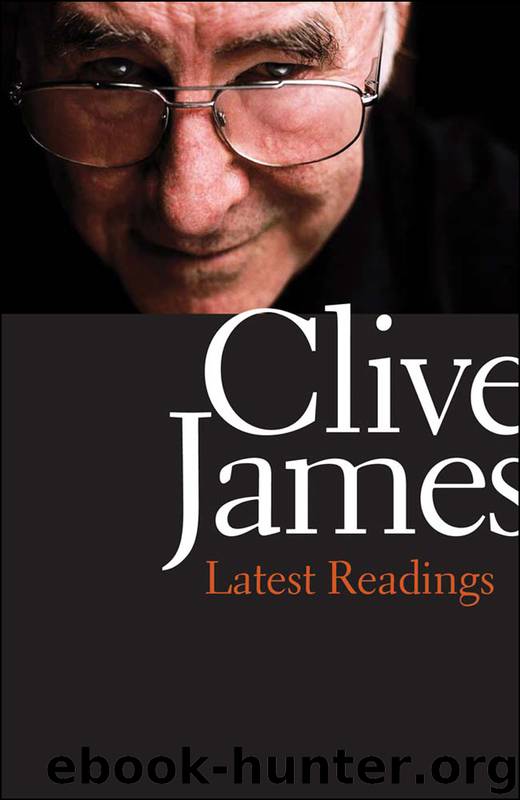
Author:Clive James
Language: eng
Format: epub
Publisher: Yale University Press
Published: 2015-11-26T05:00:00+00:00
Kipling and the Widow-maker
BACK IN 2010, during my first year of illness, I added to my woes by stupidly contriving to remain immobile in my cabin throughout an Atlantic crossing to New York, instead of walking around the deck a few times each day as I should have done. It rained all the way, but that was no excuse, because on a ship as big as the Queen Mary 2 you can do a satisfactory deck walk just by using the internal corridors. Instead, I did a long lie-down, and paid the penalty by finding out, when I arrived in New York, that I had contracted a thrombosis. After ten days in Mount Sinai hospital there was the long trip back to England, and even then I was not free of the effects. The price of safety from a further occurrence, I was told, lay in Ambulation. The doctors managed to pronounce the word with a capital “A,” and I still do so myself. Every day I Ambulate for at least half an hour, to make sure that my legs get some work to do. In the summer months the walk to town and back counts as Ambulation. I Ambulate to the bookshops, load up with a few books, and Ambulate back again. But in cold or wet weather, Ambulation must be done inside the house. It felt like a perfect waste of time until I hit upon the device of reading while I Ambulated. All I needed was a fair mental map of where the furniture was and I could Ambulate while reading Kipling’s poetry. It seemed a fitting activity because so many of his poems are written in a kind of march rhythm. They are soldierly stuff.
And yet, how brilliant. Technically, he could do anything. Here is the whole of his little four-line epic “The Sleepy Sentinel.”
Faithless the watch I kept: now I have none to keep.
I was slain because I slept; now I am slain I sleep.
Let no man reproach me again, whatever watch is unkept—
I sleep because I am slain. They slew me because I slept.
The trouble with the owner of the technique that can do anything is that he is continually tempted to do everything at once. Left to their own impulses, his poems make so much noise that they seldom settle into the condition of a statement: they are always giving you a whole symphony. Yet one must confess to a certain relief that so many of Kipling’s poems rule themselves out: whether because they are burdened by too much dialect, or too much flashy wordplay, they usefully tell us that we need not go back to them. If he had reined himself in, he would have been a poet the way he was a writer of short stories: one of the supreme exponents in the language. Even as things are, with your capacity for attention automatically whittling down the number of his poems that you would wish to revisit—and perhaps your capacity for
Download
This site does not store any files on its server. We only index and link to content provided by other sites. Please contact the content providers to delete copyright contents if any and email us, we'll remove relevant links or contents immediately.
4 3 2 1: A Novel by Paul Auster(12392)
The handmaid's tale by Margaret Atwood(7764)
Giovanni's Room by James Baldwin(7346)
Asking the Right Questions: A Guide to Critical Thinking by M. Neil Browne & Stuart M. Keeley(5775)
Big Magic: Creative Living Beyond Fear by Elizabeth Gilbert(5771)
Ego Is the Enemy by Ryan Holiday(5450)
The Body: A Guide for Occupants by Bill Bryson(5097)
On Writing A Memoir of the Craft by Stephen King(4944)
Ken Follett - World without end by Ken Follett(4732)
Adulting by Kelly Williams Brown(4574)
Bluets by Maggie Nelson(4556)
Eat That Frog! by Brian Tracy(4540)
Guilty Pleasures by Laurell K Hamilton(4449)
The Poetry of Pablo Neruda by Pablo Neruda(4109)
Alive: The Story of the Andes Survivors by Piers Paul Read(4033)
White Noise - A Novel by Don DeLillo(4010)
Fingerprints of the Gods by Graham Hancock(4004)
The Book of Joy by Dalai Lama(3986)
The Bookshop by Penelope Fitzgerald(3853)
